#charles hoskinson

Midnight Rolls Out in Phases to Strengthen Cardano

During a recent Fireside Dev chat, the Midnight team and Charles Hoskinson walked through how the partner chain model is actually playing out in practice. Rather than simply opening the gates and hoping everything works, they're taking a methodical, phased approach to de-risk the entire network before scaling up just like Cardano. Smart contract deployment is currently limited to an approved list of trusted partners, and any attempt to deploy outside that whitelist gets rejected at the network layer before it even reaches a block producer.
The team identified three specific risks they wanted to eliminate early on with value at risk by preventing exploits in untested contracts that could lock up real funds, privacy at risk by ensuring the ZK proving system is tested in a controlled environment, and state space at risk by avoiding cheap state inflation attacks while they refine their cost models.
These guardrails are designed to be temporary and milestone driven, expected to lift in 60 to 90 days once the network proves itself on value handling, privacy guarantees, and ledger stability. As Charles put it, you have to build the basement before you build the house. Currently Midnight runs on a federated set of high-assurance node operators, including Google Cloud, and this approach delivers the stability and institutional-grade uptime that enterprises require. As technical milestones are hit, the expansion sequence will open the door to broader validator participation and decentralization.
The critical point here is that Midnight isn't operating in isolation. It's built to strengthen Cardano, not compete with it. Every NIGHT token holder is structurally tied back to the Cardano ecosystem through the dual token model: NIGHT is primarily used to secure the network, DUST is generated from simply holding NIGHT and used as gas for transactions. SPOs benefit directly through new staking and operational revenue opportunities while the partner-chain design forces infrastructure upgrades that strengthen the entire Cardano network. When Midnight succeeds, Cardano succeeds. The broader industry has spent too long overlooking this ecosystem.
The team is focused on making the UX easier for end users through the Lace wallet that lets anyone generate DUST directly from their existing Cardano assets. Teams are building passkey-based onboarding so users never need seed phrases, and they're exploring sponsored transactions where enterprises or banks cover DUST costs entirely, meaning users never think about buying gas.
Real integrations are happening right now with SundaeSwap rolling out capacity exchanges with passkey onboarding, letting users create a Midnight-compatible wallet in seconds without dealing with a 24-word phrase. The broader vision includes the Midnight Passport and integrations with everyday tools like Google Drive, biometrics, and QR-code account creation in under 60 seconds. The goal is for a new user to go from zero to fully onboarded without ever seeing the blockchain.
The 1AM Wallet v5.0.1 has officially launched, bringing native Cardano integration that lets users spend, manage, and interact directly with ADA and Cardano assets without any bridges or third-party tools. It also introduces one-click DUST generation from within the wallet itself, along with a complete UI redesign, doubled sync speeds, and a significantly lower memory footprint for a faster and lighter experience overall.

Midnight brings serious credibility to the ecosystem with companies like Google and Vodafone involved from the early stages, along with fresh capital. By offloading private transactions and shielded smart contracts to the sidechain, it reduces mainnet congestion and allows each chain to focus on what it does best. The team is transparent about current limitations instead of overhyping what doesn't exist yet. They're iterating and learning in public, which stands in sharp contrast to the move-fast-and-break-things culture that has torched so many projects in this space.
Midnight isn't taking anything away from Cardano, but it's adding a privacy layer that institutions genuinely need and creating new earning opportunities for operators. The foundation is being laid right now, and the finished structure is going to justify the investment.

Midnight Mainnet Is Live, A New Era Of Blockchain Begins
This is the launch that the blockchain industry has spent years waiting for. The Midnight network has announced that mainnet is live, and with this groundbreaking moment, something that no previous generation of blockchain has managed to deliver: end-to-end programmable privacy that is flexible, enforceable, and built for the real world. After years of research, development, and collaboration involving scientists, engineers, developers, and institutional partners across the globe, the fourth generation of blockchain technology is officially here.
The timing could not feel more significant. Within days of the mainnet going live, Midnight confirmed what may be the most consequential real-world blockchain deal announced in years. Monument Bank, a Bank of England-regulated institution serving over 100,000 clients with more than 7 billion pounds in savings deposits, announced plans to tokenize up to 250 million pounds of retail customer deposits directly on the Midnight network. Those deposits remain interest-bearing, fully backed in sterling, and protected under the UK's Financial Services Compensation Scheme. It is the first time a UK-regulated bank has ever moved retail deposits onto a public blockchain, and it happened at the exact moment Midnight's mainnet came to life.
Charles Hoskinson, founder of Input Output Group and the visionary behind Midnight and Cardano, was candid about the scale of what this represents. Writing on X following the Monument announcement, he called it "one of the largest deals we've ever done" and said it could bring "hundreds of millions to billions of TVL" to the Midnight ecosystem. More striking is what Monument Technology plans to do next: offer the same tokenized deposit infrastructure to other banks through a Banking-as-a-Service platform.
A New Generation of Blockchain, Built for the Real World
To understand why this launch matters so much, it helps to understand what came before it. Hoskinson has framed Midnight's arrival in the clearest possible terms: Satoshi gave us sound money, Ethereum gave us programmability, Cardano brought interoperability and governance, and Midnight "gives us our identity and privacy back." Each generation solved the limitations of the last. Midnight is solving the biggest one remaining.
The world's value has stayed off-chain for a reason. Trillions of dollars in real estate, private equity, debt, and currency cannot be digitized on transparent public ledgers without exposing the sensitive data that institutions and individuals depend on keeping private. Midnight changes that equation fundamentally. Its hybrid ledger architecture combines public and private data, allowing applications to process and verify sensitive personal, financial, and commercial information without ever exposing it to the network. Zero-knowledge proofs are generated locally on a user's device and submitted for validation, meaning identity, credit, and compliance verification can all happen on-chain with the underlying data never leaving the user's hands.
The tokenomics are equally well-designed for mainstream adoption. Midnight operates on a dual-component model: NIGHT, the governance and utility token, and DUST, the renewable resource used to power transactions. NIGHT holders generate DUST over time, and developers can hold NIGHT to cover transaction costs for their users entirely. For the first time, end-users can interact with a blockchain-powered application without ever needing to hold or even be aware of a crypto token. That is not a small thing. That is how you build for a billion users.
The caliber of institutions that signed on to run Midnight's founding federated nodes is genuinely unprecedented for a blockchain launch. Google Cloud, MoneyGram, Vodafone's Pairpoint division, eToro, Blockdaemon, Bullish, Worldpay, AlphaTON Capital, and Shielded Technologies are all running live infrastructure on the Midnight network right now. This is not a list of logos on a website. These entities are producing blocks on a live, production blockchain.
Consider what each of those names brings. Blockdaemon secures over 110 billion dollars in digital assets across networks globally. MoneyGram operates payment infrastructure spanning more than 200 countries and territories, and is already exploring how private on-chain payments can flow across that entire footprint. eToro carries more than 35 million registered users. Google Cloud brings enterprise-grade infrastructure and Confidential Computing capabilities backed by Mandiant security monitoring. Hoskinson put it plainly at launch: "For the first time, organisations of this scale have committed not only to running critical infrastructure but also to building and deploying live applications on a public network."
The rollout is structured in phases, which reflects how seriously the Midnight Foundation is taking stability and security at this stage. The current Kukolu phase establishes the operational foundation. The Mohalu phase, targeted for Q2 2026, will bring in Cardano stake pool operators and activate the DUST Capacity Exchange, beginning the move toward broader decentralization. Full cross-chain interoperability with networks including Ethereum and Solana is planned for the Hua phase in Q3 2026. This is a network being built to last, not rushed to market.
Privacy That Works With Compliance, Not Against It
What makes Midnight's privacy architecture so significant is that it has been designed from the ground up for regulated environments. This is not a privacy coin. Midnight is not trying to make transactions untraceable. What it delivers is something far more powerful for institutional adoption: the ability to prove facts about data without revealing the data itself. KYC status, solvency, eligibility, and settlement completion can all be verified on-chain while the underlying customer records remain completely shielded from public view.
The scale of the opportunity this unlocks is staggering. Aleo's 2025 Privacy Gap Report found that approximately 1.22 trillion dollars in institutional stablecoin transaction volume currently moves through on-chain rails, with just 0.0013% of that settling on privacy-enabled infrastructure. The gap has not existed because institutions lack interest. It has existed because no compliant privacy tooling was available. Midnight is the tooling. The Monument deal is the proof.
Midnight Foundation President Fahmi Syed captured the broader vision at launch: "When privacy is built into the system itself, it becomes possible to bring real-world activity and assets on-chain without exposing the underlying data, unlocking entirely new forms of economic value that were previously impossible on transparent infrastructure." That is not marketing language. It is a description of what the Monument deal already demonstrates in practice.
The Community Behind the Network
Midnight arrived at its genesis block with one of the broadest token holder bases in blockchain history already in place. The Glacier Drop distribution attracted participants from across eight major blockchain ecosystems, with over 3.5 billion NIGHT tokens claimed. A second phase, the Scavenger Mine, drew over 8 million unique wallet addresses, setting an industry record for distribution volume. NIGHT is now live on Kraken, OKX, Binance, Bitpanda, and a growing list of exchanges, and gained around 5% in the days immediately leading up to the mainnet launch as the momentum built.
The developer community has also been building with real urgency. The Midnight Summit hackathon in November 2025 brought together over 120 builders working on privacy applications across healthcare, AI, governance, and finance. Smart contract deployments on the Preprod network surged 1,617% in November alone. Midnight's Compact smart contract language, a domain-specific language built on familiar TypeScript syntax, is already enabling developers to build ZK-powered applications without needing years of cryptographic expertise. The technical barrier to building on Midnight is lower than it has ever been for any privacy-focused network.
There is a real sense across the space that something genuinely new has arrived. Hoskinson's generational framing resonates because the history backs it up. Bitcoin, Ethereum, and Cardano each opened doors that the previous generation could not. Midnight opens the door to the world's real economy, the trillions in assets that have remained off-chain because no infrastructure could protect them adequately. That door is now open. The genesis block has been written, the institutional partners are live, the first bank deal is signed, and the ecosystem is just getting started. The dawn of Midnight is here.
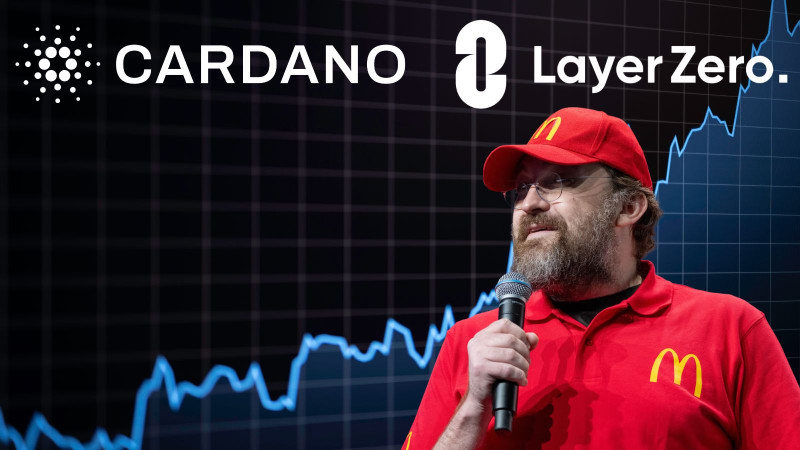
Cardano Unveils LayerZero Partnership, Midnight Launch

Consensus Hong Kong delivered no shortage of headlines this year, but few were as consequential for the Cardano ecosystem as Charles Hoskinson’s back-to-back announcements on privacy and interoperability.
In a keynote that felt both technical and strategic, the Cardano founder confirmed two major developments: the long-awaited debut of the privacy-focused Midnight blockchain in late March, and a formal deal to integrate LayerZero’s omnichain messaging protocol with Cardano.
Taken together, the moves signal something bigger than incremental upgrades. Cardano is positioning itself for a new phase, one centered on compliant privacy and seamless cross-chain liquidity.
LayerZero Brings Cardano Into the Multichain Era
Hoskinson confirmed that Cardano will integrate LayerZero, one of the most widely adopted interoperability protocols in crypto.
LayerZero enables cross-chain messaging and asset transfers without relying on centralized custodians. In simple terms, it allows blockchains to talk to each other more directly and more securely.
For Cardano, which has often been criticized for operating in relative isolation from Ethereum-centric DeFi liquidity, this is a structural shift. The integration is expected to connect Cardano to more than 150 other chains supported by LayerZero’s infrastructure. That includes major ecosystems where most decentralized finance activity currently resides.
The practical implications are clear. Assets native to Cardano could move across chains more fluidly. Omnichain fungible tokens can be deployed in ways that maintain unified liquidity rather than fragmenting it across bridges. Stablecoins and wrapped assets can circulate with fewer technical barriers.
The rollout will happen in phases, starting with the deployment of LayerZero endpoint contracts on Cardano. From there, developers will be able to build omnichain applications that treat Cardano as one node in a much larger interconnected system.
This move into high-speed cross-chain infrastructure feels like an acknowledgment of where the broader market has gone. Liquidity is multichain. Users are multichain. Capital flows are multichain. I'm glad that the ecosystem seems to have finally realized that it needs to not be an island.
Midnight Is Finally Almost Here
After years of discussion and gradual buildout, Midnight now has a timeline. Hoskinson told attendees that the privacy-focused partner chain is set to launch its mainnet in late March 2026.
Midnight is designed to bring programmable privacy to decentralized applications without turning the network into a regulatory red flag. The core idea is selective disclosure. Transactions and smart contract interactions can remain confidential by default, but information can be revealed to authorized parties when required.
That distinction matters. Pure privacy coins have long faced scrutiny from regulators and exchanges. Midnight’s pitch is different. Instead of marketing itself as a tool for the already privacy-obsessed, it aims to embed privacy as a standard feature for everyday users and enterprise applications.
Hoskinson described the approach as pragmatic rather than ideological. In practical terms, Midnight relies heavily on zero knowledge cryptography to allow confidential smart contracts and private state transitions. Developers can build applications where sensitive business logic or user data is shielded on chain, while still maintaining the ability to meet compliance demands.
To support the launch, the team also unveiled a privacy simulation platform. The goal is to model how Midnight behaves under different scenarios before full production rollout. For institutions and enterprise developers watching from the sidelines, that kind of testing framework is meant to reduce uncertainty.
A Broader Institutional Pitch
Midnight’s compliance-friendly privacy model and LayerZero’s connectivity are huge news for an ecosystem that has struggled to find its place in the broader market. Together, they sketch a vision of Cardano as infrastructure for regulated DeFi, tokenized assets, and enterprise use cases that require both confidentiality and interoperability.
Still, markets do not always move in lockstep with roadmaps. ADA’s price action around the conference was measured rather than euphoric, a reminder that traders often demand shipped products and sustained traction before repricing a network’s long term thesis.
What Cardano delivered in Hong Kong was concrete timelines and signed deals. If these sort of announcements continue to be made with measurable results, the price action could follow.
The Bottom Line
Stepping back, the announcements mark a subtle but important transition. Cardano is evolving slowly from a self-contained network into something more layered and more interconnected.
Midnight adds a privacy execution environment tailored for compliant applications. LayerZero plugs Cardano into the liquidity highways that already define modern crypto.
If the next few months go according to plan, late March will bring the Midnight mainnet, and the months that follow will bring the first wave of omnichain deployments.
For Cardano, Consensus Hong Kong may be remembered less as a moment of spectacle and more as the start of a structural shift. Privacy and interoperability are no longer side conversations. They are now central pillars of the roadmap.
IOHK: Pioneering Blockchain Infrastructure for a Transparent Future
In the realm of blockchain infrastructure research and engineering, few names resonate as powerfully as IOHK.

Founded in 2015 by Charles Hoskinson and Jeremy Wood, IOHK stands as a testament to the transformative power of blockchain technology, committed to the highest academic rigor and evidence-based software development principles.
This article will delve into the heart of IOHK and discuss its mission, impact, and vision for the future.
The Genesis of IOHK
Input Output Hong Kong, or IOHK, was conceived to leverage peer-to-peer innovations to provide financial services to the 3 billion people who lack them.
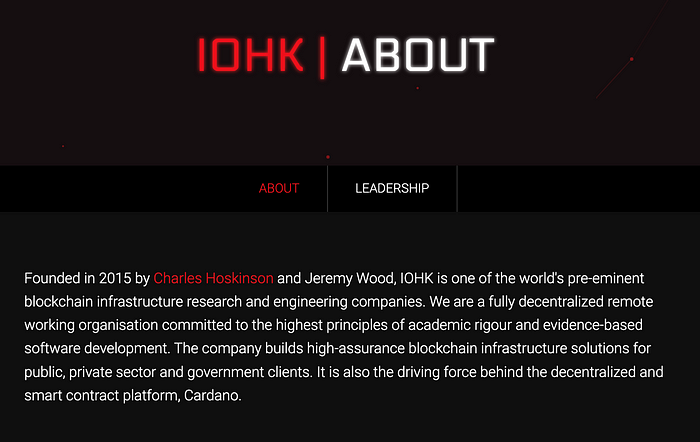
The company operates as a fully decentralized remote working organization, with a global team of over 400 people across more than 50 countries.
This diverse team brings together different skill sets, cultural perspectives, and life stages, enriching the company’s culture and enhancing its global impact.
The Driving Force Behind Cardano
IOHK is not just a research and engineering company but also the driving force behind Cardano, a decentralized cryptocurrency and smart contract platform.
Cardano is a testament to IOHK’s commitment to building high-assurance blockchain infrastructure solutions for the public, private sector, and government clients.
The Principle of Cascading Disruption
At the core of IOHK’s philosophy is the concept of “cascading disruption.”
This idea posits that most structures that form the world’s financial, governance, and social systems are inherently unstable. As such, minor perturbations can cause a ripple effect that fundamentally reconfigures the entire system.
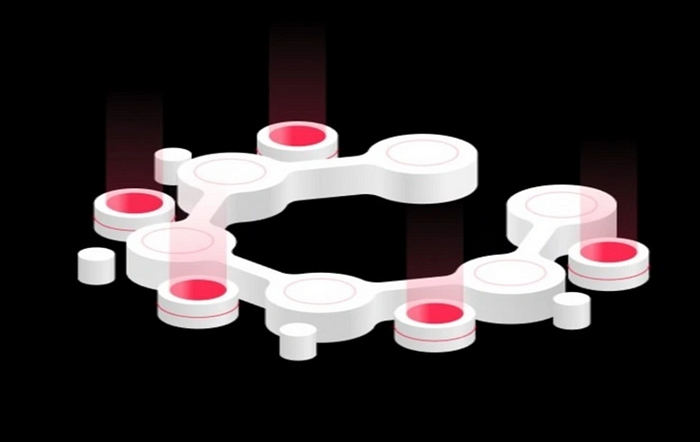
IOHK is committed to identifying and developing technology to force these perturbations, pushing towards a more fair and transparent order. It’s a bold and ambitious mission that IOHK is uniquely positioned to undertake.
This mission is not just about disrupting existing systems but about building new ones that are more equitable, transparent, and efficient. It’s about leveraging the power of blockchain technology to create a world where a select few do not control the flow of ideas and value but is accessible to all.
Looking Ahead: The Future of IOHK
IOHK’s mission becomes even more critical as we look to the future.
The need for transparent, secure, and equitable systems becomes more urgent as the world becomes increasingly digital.
IOHK, with its commitment to academic rigor, evidence-based software development, and cascading disruption, is poised to lead the charge in this new digital frontier.
Learn More and Stay Tuned
IOHK is more than just a company; it’s a movement.
It’s a collective of individuals worldwide committed to using technology to create a more fair and transparent world. Whether you’re a blockchain enthusiast, a tech-savvy individual, or just someone interested in the future of our digital world, IOHK is a company worth watching.
Remember, the future is not something that happens to us.
It’s something we create.
With companies like IOHK leading the charge, we can create a technologically advanced, equitable, and transparent future.
So, let’s seize that opportunity, be part of the change and create the future.
Let’s not waste that chance.
Connect With IOHK
IOHK is a premier blockchain infrastructure research and engineering company, and the driving force behind the Cardano ecosystem. With a commitment to academic rigor, evidence-based software development, and cascading disruption, IOHK is shaping the future of digital systems towards a more connected, transparent, and fair configuration.
IOHK is also an exhibitor at Rare Evo, the premier blockchain and cryptocurrency conference bringing Web3 to the Rockies. Merging business and pleasure in a luxurious environment, IOHK’s participation in Rare Evo underscores the company’s commitment to being an active player in the blockchain ecosystem and beyond.
To stay updated with the latest news and developments, you can follow IOHK on various social media platforms. Connect with them on Twitter for real-time updates, join the professional network on LinkedIn, or subscribe to their YouTube channel for informative videos. You can also like their Facebook page, follow their Instagram for behind-the-scenes content, check out their code on GitHub, or join the conversation on Reddit and Telegram.
About The Rare Network
The Rare Network is a dynamic and growing organization that bridges the gap between traditional industry and emerging blockchain technology.
Our flagship event, Rare Evo, is the premier blockchain conference that brings together multi-chain projects, industry leaders, investors, and enthusiasts.
Rare Evo isn’t just a convention. It’s an immersive experience set in Denver, Colorado. We’ve got everything from educational sessions and networking opportunities to interactive experiences and live entertainment.
Hosted at the stunning Gaylord Rockies Resort, our luxurious and family-friendly venue ensures there’s something for everyone.
Don’t miss out on this game-changing event!
Buy your tickets, book your hotel room, and join the Web3 revolution.
Remember to stay connected with us on Twitter, YouTube, and Discord for the latest updates.