#blockchain technology

Midnight Mainnet Is Live, A New Era Of Blockchain Begins

This is the launch that the blockchain industry has spent years waiting for. The Midnight network has announced that mainnet is live, and with this groundbreaking moment, something that no previous generation of blockchain has managed to deliver: end-to-end programmable privacy that is flexible, enforceable, and built for the real world. After years of research, development, and collaboration involving scientists, engineers, developers, and institutional partners across the globe, the fourth generation of blockchain technology is officially here.
The timing could not feel more significant. Within days of the mainnet going live, Midnight confirmed what may be the most consequential real-world blockchain deal announced in years. Monument Bank, a Bank of England-regulated institution serving over 100,000 clients with more than 7 billion pounds in savings deposits, announced plans to tokenize up to 250 million pounds of retail customer deposits directly on the Midnight network. Those deposits remain interest-bearing, fully backed in sterling, and protected under the UK's Financial Services Compensation Scheme. It is the first time a UK-regulated bank has ever moved retail deposits onto a public blockchain, and it happened at the exact moment Midnight's mainnet came to life.
Charles Hoskinson, founder of Input Output Group and the visionary behind Midnight and Cardano, was candid about the scale of what this represents. Writing on X following the Monument announcement, he called it "one of the largest deals we've ever done" and said it could bring "hundreds of millions to billions of TVL" to the Midnight ecosystem. More striking is what Monument Technology plans to do next: offer the same tokenized deposit infrastructure to other banks through a Banking-as-a-Service platform.
A New Generation of Blockchain, Built for the Real World
To understand why this launch matters so much, it helps to understand what came before it. Hoskinson has framed Midnight's arrival in the clearest possible terms: Satoshi gave us sound money, Ethereum gave us programmability, Cardano brought interoperability and governance, and Midnight "gives us our identity and privacy back." Each generation solved the limitations of the last. Midnight is solving the biggest one remaining.
The world's value has stayed off-chain for a reason. Trillions of dollars in real estate, private equity, debt, and currency cannot be digitized on transparent public ledgers without exposing the sensitive data that institutions and individuals depend on keeping private. Midnight changes that equation fundamentally. Its hybrid ledger architecture combines public and private data, allowing applications to process and verify sensitive personal, financial, and commercial information without ever exposing it to the network. Zero-knowledge proofs are generated locally on a user's device and submitted for validation, meaning identity, credit, and compliance verification can all happen on-chain with the underlying data never leaving the user's hands.
The tokenomics are equally well-designed for mainstream adoption. Midnight operates on a dual-component model: NIGHT, the governance and utility token, and DUST, the renewable resource used to power transactions. NIGHT holders generate DUST over time, and developers can hold NIGHT to cover transaction costs for their users entirely. For the first time, end-users can interact with a blockchain-powered application without ever needing to hold or even be aware of a crypto token. That is not a small thing. That is how you build for a billion users.
The caliber of institutions that signed on to run Midnight's founding federated nodes is genuinely unprecedented for a blockchain launch. Google Cloud, MoneyGram, Vodafone's Pairpoint division, eToro, Blockdaemon, Bullish, Worldpay, AlphaTON Capital, and Shielded Technologies are all running live infrastructure on the Midnight network right now. This is not a list of logos on a website. These entities are producing blocks on a live, production blockchain.
Consider what each of those names brings. Blockdaemon secures over 110 billion dollars in digital assets across networks globally. MoneyGram operates payment infrastructure spanning more than 200 countries and territories, and is already exploring how private on-chain payments can flow across that entire footprint. eToro carries more than 35 million registered users. Google Cloud brings enterprise-grade infrastructure and Confidential Computing capabilities backed by Mandiant security monitoring. Hoskinson put it plainly at launch: "For the first time, organisations of this scale have committed not only to running critical infrastructure but also to building and deploying live applications on a public network."
The rollout is structured in phases, which reflects how seriously the Midnight Foundation is taking stability and security at this stage. The current Kukolu phase establishes the operational foundation. The Mohalu phase, targeted for Q2 2026, will bring in Cardano stake pool operators and activate the DUST Capacity Exchange, beginning the move toward broader decentralization. Full cross-chain interoperability with networks including Ethereum and Solana is planned for the Hua phase in Q3 2026. This is a network being built to last, not rushed to market.
Privacy That Works With Compliance, Not Against It
What makes Midnight's privacy architecture so significant is that it has been designed from the ground up for regulated environments. This is not a privacy coin. Midnight is not trying to make transactions untraceable. What it delivers is something far more powerful for institutional adoption: the ability to prove facts about data without revealing the data itself. KYC status, solvency, eligibility, and settlement completion can all be verified on-chain while the underlying customer records remain completely shielded from public view.
The scale of the opportunity this unlocks is staggering. Aleo's 2025 Privacy Gap Report found that approximately 1.22 trillion dollars in institutional stablecoin transaction volume currently moves through on-chain rails, with just 0.0013% of that settling on privacy-enabled infrastructure. The gap has not existed because institutions lack interest. It has existed because no compliant privacy tooling was available. Midnight is the tooling. The Monument deal is the proof.
Midnight Foundation President Fahmi Syed captured the broader vision at launch: "When privacy is built into the system itself, it becomes possible to bring real-world activity and assets on-chain without exposing the underlying data, unlocking entirely new forms of economic value that were previously impossible on transparent infrastructure." That is not marketing language. It is a description of what the Monument deal already demonstrates in practice.
The Community Behind the Network
Midnight arrived at its genesis block with one of the broadest token holder bases in blockchain history already in place. The Glacier Drop distribution attracted participants from across eight major blockchain ecosystems, with over 3.5 billion NIGHT tokens claimed. A second phase, the Scavenger Mine, drew over 8 million unique wallet addresses, setting an industry record for distribution volume. NIGHT is now live on Kraken, OKX, Binance, Bitpanda, and a growing list of exchanges, and gained around 5% in the days immediately leading up to the mainnet launch as the momentum built.
The developer community has also been building with real urgency. The Midnight Summit hackathon in November 2025 brought together over 120 builders working on privacy applications across healthcare, AI, governance, and finance. Smart contract deployments on the Preprod network surged 1,617% in November alone. Midnight's Compact smart contract language, a domain-specific language built on familiar TypeScript syntax, is already enabling developers to build ZK-powered applications without needing years of cryptographic expertise. The technical barrier to building on Midnight is lower than it has ever been for any privacy-focused network.
There is a real sense across the space that something genuinely new has arrived. Hoskinson's generational framing resonates because the history backs it up. Bitcoin, Ethereum, and Cardano each opened doors that the previous generation could not. Midnight opens the door to the world's real economy, the trillions in assets that have remained off-chain because no infrastructure could protect them adequately. That door is now open. The genesis block has been written, the institutional partners are live, the first bank deal is signed, and the ecosystem is just getting started. The dawn of Midnight is here.
Tether Launches Open Bitcoin Mining Operating System

Tether is best known for issuing USDT, the stablecoin that underpins much of the crypto market’s daily liquidity. But over the past few years, the company has been quietly expanding far beyond stablecoins. Its latest move pushes it even deeper into Bitcoin’s core infrastructure.
Tether has launched an open-source operating system designed specifically for Bitcoin mining. The software, called MiningOS, is meant to compete with the proprietary platforms that currently run much of the global mining industry. Unlike those systems, MiningOS is free, open to inspection, and designed to operate without centralized control.
It is a technical release, but also a philosophical one. At a time when Bitcoin mining is increasingly dominated by large, well-funded players, Tether is positioning itself as a company willing to open the tooling layer and lower at least some of the barriers to participation.
What MiningOS Is and Why It Matters
MiningOS is software that helps miners manage and coordinate their machines. It handles things like monitoring performance, configuring devices, managing power usage, and scaling operations across large numbers of mining rigs.
That may not sound exciting, but in mining, software choices matter a lot. Most large mining firms rely on closed, proprietary systems that are licensed and often tied to specific hardware vendors. These platforms work well, but they come with fees, restrictions, and limited transparency.
MiningOS takes a different approach. It is modular, meaning operators can adapt it to different setups and environments. It can run on lightweight hardware for small operations, but it is also designed to scale to industrial mining sites with thousands of machines.
One of the more interesting aspects is its peer-to-peer architecture. Instead of relying on centralized servers, devices communicate directly with one another. That design choice can reduce infrastructure costs and make operations more resilient, especially in environments where connectivity or uptime is a concern.
By making the software open source, Tether is also allowing anyone to inspect the code, modify it, or build on top of it. That alone is a big departure from how mining software has traditionally been distributed.
Why Tether Is Doing This Now
This release fits into a much broader shift inside Tether. The company has been steadily moving into mining, energy infrastructure, and artificial intelligence, positioning itself as more than just a stablecoin issuer.
Timing also matters. Bitcoin mining has become a tougher business, especially after the most recent halving cut block rewards again. Margins are tighter, competition is intense, and efficiency is everything. For miners trying to stay profitable, cutting software costs and gaining more control over operations can make a real difference.
At minimum, MiningOS gives miners another option. At best, it could force existing software providers to compete harder on transparency, pricing, and flexibility.
A Direct Challenge to Proprietary Mining Software
The mining software market rarely gets attention, but it has real influence. Whoever controls the software often controls how hardware is deployed, optimized, and integrated with pools and power systems.
An open-source alternative disrupts that model. Miners can audit the code themselves, customize it for specific environments, or adapt it to unusual power setups. They are no longer forced to trust a black box or depend on a vendor’s roadmap.
For smaller and mid-sized miners, this could be especially valuable. Licensing fees may not be the biggest expense in mining, but when margins are thin, every recurring cost matters. Removing software fees lowers the break-even point and gives operators more room to adapt.
There is also a broader network effect to consider. Bitcoin’s security depends on distributed hash power. Anything that makes it easier for independent miners to stay online and competitive helps reinforce that foundation, even if the impact is gradual rather than immediate.
Limits and Open Questions
This is not a magic solution. Mining is still capital-intensive and energy-dependent. Open-source software does not solve access to cheap electricity, hardware supply, or regulatory pressure.
Adoption will also take time. Mining operators tend to be conservative with infrastructure changes, especially when uptime and reliability are critical. MiningOS will need to prove itself in real-world deployments, not just in theory.
There is also the question of trust. Tether remains a controversial company in parts of the crypto world. Even with open-source code, some miners and developers may be hesitant to engage until the project builds a track record and an active community.
Still, the fact that the code is open means the software can outgrow its origin. If it is useful, the ecosystem can take it in directions Tether itself may not control.
The Bottom Line
I like this move. Open-sourcing mining software feels overdue in an industry that depends so heavily on closed systems most people never see. For all the talk about decentralization in Bitcoin, a surprising amount of the mining stack has remained locked behind proprietary tools and vendor agreements. This at least pushes in the opposite direction.
Will this suddenly make Bitcoin mining accessible to everyone? No. Power, hardware, and capital still matter, probably more than software ever will. But removing one layer of friction does count, especially at a time when miners are under real pressure to cut costs and stay flexible.
I am also glad this is open source rather than another branded platform with a free tier and strings attached. Anyone can inspect it, improve it, or fork it if they want. That alone changes the power dynamic. Even miners who never run MiningOS may benefit if existing software vendors are forced to be more transparent or more competitive as a result.
Tether is a complicated company, and skepticism around anything it touches is fair. But good ideas do not stop being good just because they come from a controversial source. Open infrastructure tends to outlive the companies that release it, and that is sort of the point.
If Bitcoin is going to stay resilient over the long run, it needs more open tools at the base layer, not fewer. On that front, this feels like a step in the right direction, and I am genuinely happy to see it happen.
Midnight Launches December 8, A New Era of Privacy For Blockchain
Midnight, A New Era Of Privacy For Blockchain
On December 8, Midnight finally goes live. This is the moment the industry has been waiting for. Midnight is not just a new chain and not just another project. It is a fully engineered, zero knowledge powered data protection network that brings real confidentiality to blockchain without sacrificing compliance, security or transparency.
The launch of Midnight marks the beginning of a new era where individuals, developers and global enterprises can use blockchain without exposing everything to the public. Midnight introduces a rational privacy that is programmable, auditable and built for long term scale. There is nothing else like it in the market.
What Makes Midnight So Powerful
Midnight solves the problem that has limited every major blockchain from reaching full global adoption. Public ledgers reveal personal data, business logic, financial activity and sensitive operations. This stops enterprises from deploying real systems on chain. Midnight flips that limitation into strength.
Developers can create smart contracts with confidential logic, private state updates and selective disclosure. Midnight lets you reveal only what is required while keeping everything else shielded through zero knowledge proofs, enabling real-world application.
Because of its privacy centric architecture, Midnight unlocks use cases that have never been possible at scale.
-
Private decentralized finance
-
Confidential business workflows
-
Secure identity systems
-
Tokenized documents and assets with controlled access
-
Encrypted supply chain data
-
Private DAO voting
-
Permission controlled data sharing between institutions
Midnight is built specifically for these high value industries. This is why the launch tomorrow is so significant, a production ready privacy network designed for global use.
The December 8 launch is only the beginning of Midnight’s long term vision. Midnight is following a structured, multi phase roadmap that gradually increases capability, decentralization and real world utility. Each phase expands the network in a controlled and secure way, ensuring that privacy and identity features scale responsibly.
Below is a clear breakdown of Midnight’s roadmap based on the official announcement.
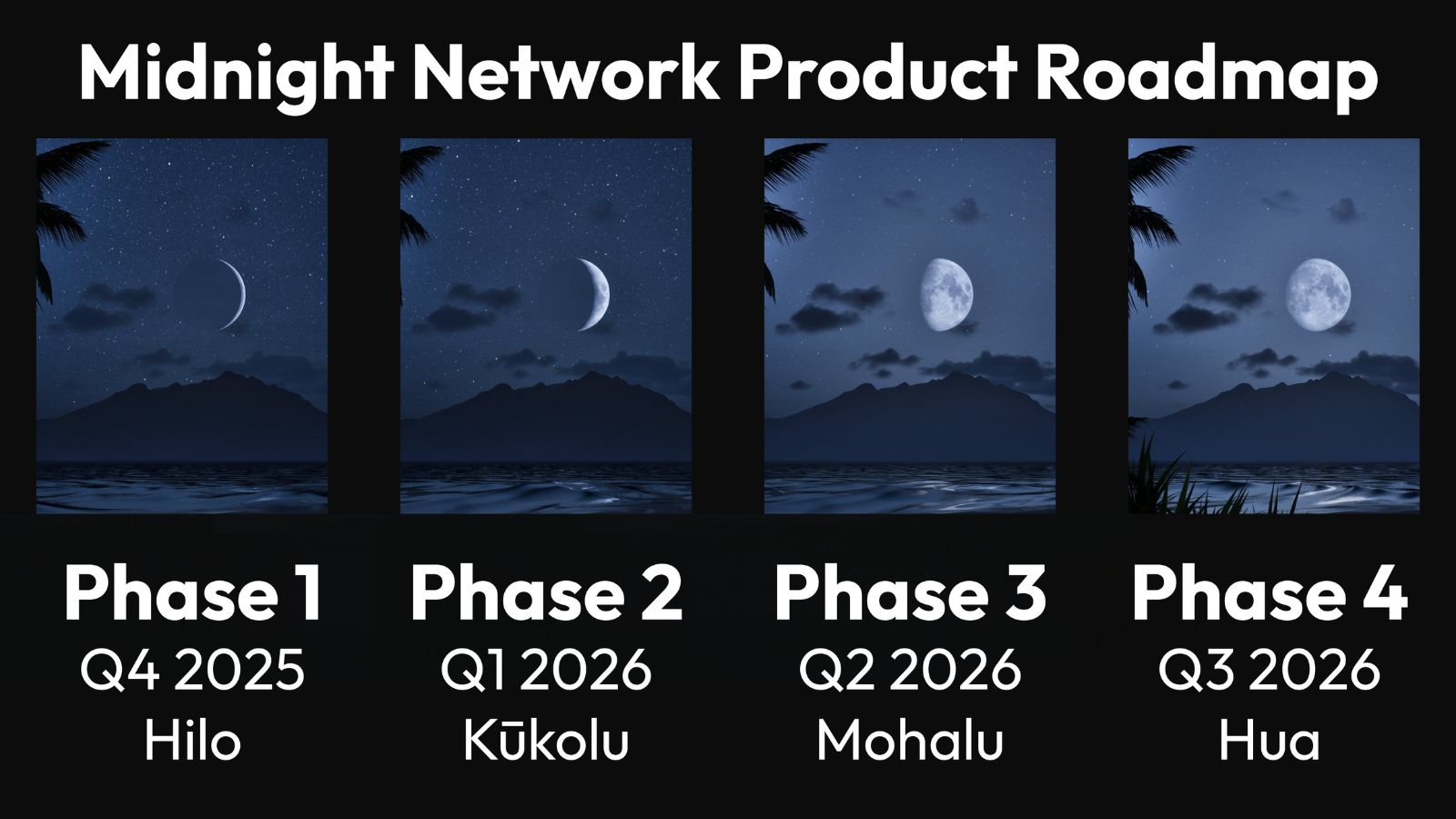
Phase 1: Hilo
Launch and Token Liquidity
This is the phase that begins with the December 8 activation of the Midnight network. Midnight becomes a live, operational chain with NIGHT available as a liquid asset.
Key elements of Phase 1:
-
Network activation and operational readiness
-
NIGHT becomes tradable and usable
-
Early participants, wallets and partners join the ecosystem
-
The foundation is set for developers to begin exploring Midnight’s capabilities
Hilo marks the transition from development into a functioning privacy network that users and builders can interact with directly.
Phase 2: Kūkolu
Federated Mainnet and Privacy Enabled Applications
During this stage, Midnight moves from initial activation into a federated mainnet operated by a combination of foundation validators and trusted partners. This creates a controlled yet fully functional environment for deploying real applications.
Highlights of Phase 2:
-
Federated mainnet with a secure validator set
-
Launch of the first privacy enabled DApps using Midnight’s zero knowledge architecture
-
Real applications begin leveraging features such as selective disclosure, private state, confidential identity and shielded computation
This is where Midnight shifts from infrastructure into a true application platform. Developers begin delivering privacy focused solutions that cannot be built on transparent chains.
Phase 3: Mōhalu
Network Scaling, Increased Participation and the Capacity Market
Mōhalu expands Midnight toward broader community participation. Block production begins opening up to more operators and the network starts preparing for full decentralization.
Core advancements in Phase 3:
-
Wider validator participation including future stake pool operators and community nodes
-
Stress testing and economic validation of the network
-
Activation of the DUST capacity exchange that powers private computation
-
Community involvement in testing scalability, privacy performance and governance mechanisms
This phase transforms Midnight from a limited validator model into an emerging decentralized network with a functioning economic system based on NIGHT and DUST.
Phase 4: Hua
Full Decentralization, Hybrid DApps and Cross Chain Privacy
Phase 4 represents the full maturity of Midnight. The network completes its transition into a decentralized, community governed privacy platform.
Key outcomes of Phase 4:
-
Complete decentralization of block production
-
NIGHT holders govern the network through on chain voting and proposal systems
-
Support for Hybrid DApps that integrate Midnight’s privacy layer into other chains and platforms
-
Cross chain interoperability where other networks can use Midnight as a privacy and identity service
At this stage, Midnight becomes not only a standalone privacy chain but also a universal privacy infrastructure for the broader blockchain industry.
Midnight Brings a New Dawn For Cardano
Even though Midnight is its own network, it operates as a data protection partner chain anchored to Cardano. This creates enormous value for ADA holders, Cardano developers and the entire ecosystem.
Cardano becomes the only major blockchain ecosystem with a production level privacy chain that remains regulation friendly. This is a massive competitive advantage. Cardano can now serve transparent applications and private applications without compromising security.
NIGHT is a Cardano native asset. Anyone who wants to use Midnight must interact with the Cardano ecosystem. This brings new wallets, new users, new liquidity and new developers directly into Cardano from multiple external ecosystems.
Cardano is now positioned as a realistic option for industries that need confidentiality. Finance, healthcare, supply chain, identity, enterprise management systems. These businesses can use Midnight for private computation while relying on the stability and settlement layer of Cardano.
Cardano has always focused on research, formal methods and sustainable architecture. Midnight takes that foundation and adds a powerful privacy dimension. This is the kind of advancement that reshapes how the industry sees Cardano.
Midnight is not a side project. It is a core evolution of the ecosystem.
How to Claim Your NIGHT Tokens
If you earned NIGHT through the Midnight distribution, the process to claim and redeem your tokens is straightforward once you know what to expect.
Step 1: Make Your Claim
Start by heading to the official Midnight Claim Portal. You will be asked for two things.
Your origin address
This is the address from the chain where you qualified. It might be a Cardano address or it could be from another supported chain like Bitcoin, Ethereum, Solana, XRP, BNB, Avalanche, or BAT. Midnight uses this to verify that you were eligible at the snapshot.
Your destination address
This is your Cardano wallet where you want to receive your NIGHT tokens. Any supported Cardano wallet works, as long as it is one you personally control.
Once both addresses are entered, you will need to accept the terms and sign a short verification message. This proves you actually own the origin address. After you submit everything, your NIGHT allocation is officially claimed and locked in the system.
Step 2: Wait for Your Tokens to Thaw
This is where Midnight does things a little differently. Your tokens do not unlock all at once. Instead, your allocation gradually thaws over a 360 day schedule. Midnight splits your total amount into four equal parts and each one unlocks roughly every ninety days.
The first unlock happens at a random time somewhere in the first ninety days after you claim. After that, each remaining quarter unlocks in sequence. It is a slow and steady release rather than a single burst, which helps keep the ecosystem healthy during the first year.
Step 3: Redeem the Unlocked Portion
Once your first portion has thawed, you can redeem it right away.
Go back to the Claim Portal, choose the unlocked portion and confirm the redemption. Your Cardano wallet will ask you to approve a small transaction fee. After the transaction goes through, your NIGHT tokens will appear in your wallet under the correct policy ID.
You can redeem each portion as it unlocks or wait until the end and redeem everything at once. It is entirely up to you.
Step 4: Do Not Miss the Grace Period
When the main redemption window ends, Midnight gives everyone an additional grace period to collect anything they have not redeemed yet. It is always best to stay on top of your thaw schedule, but the grace period gives you a buffer in case you miss something.
Once that time expires, collecting unredeemed tokens becomes a much more manual process, and it is not something you want to deal with if you can avoid it.
A Few Helpful Tips
-
Always use the official Midnight Claim Portal, not third party links.
-
Make sure your origin address comes from a wallet you control, since you need to sign the verification message.
-
Keep a bit of ADA in your Cardano wallet so you can cover redemption fees.
-
Double check your destination address before submitting. It is worth the extra moment.
Midnight Changes Everything
Midnight is not launching as an experiment. It is launching as a fully engineered, privacy centric blockchain ready for real adoption. December 8 is the beginning of a network built for global scale and long term impact.
Midnight brings confidential smart contracts into the mainstream. It gives developers the tools they have needed for years. It gives institutions a way to embrace blockchain without risking sensitive data. It gives Cardano a massive new frontier for growth.
Most of all, Midnight shows the world that privacy and transparency can work together. The chain is built to protect people, empower businesses and open the door to applications that were never possible before.
This is the start of a major shift in the industry. Midnight is ready. December 8 is the breakthrough moment.
Stay Connected
You can stay up to date on all News, Events, and Marketing of Rare Network, including Rare Evo: America’s Premier Blockchain Conference, happening July 28th-31st, 2026 at The ARIA Resort & Casino, by following our socials on X, LinkedIn, and YouTube.
IOHK: Pioneering Blockchain Infrastructure for a Transparent Future
In the realm of blockchain infrastructure research and engineering, few names resonate as powerfully as IOHK.
Founded in 2015 by Charles Hoskinson and Jeremy Wood, IOHK stands as a testament to the transformative power of blockchain technology, committed to the highest academic rigor and evidence-based software development principles.
This article will delve into the heart of IOHK and discuss its mission, impact, and vision for the future.
The Genesis of IOHK
Input Output Hong Kong, or IOHK, was conceived to leverage peer-to-peer innovations to provide financial services to the 3 billion people who lack them.
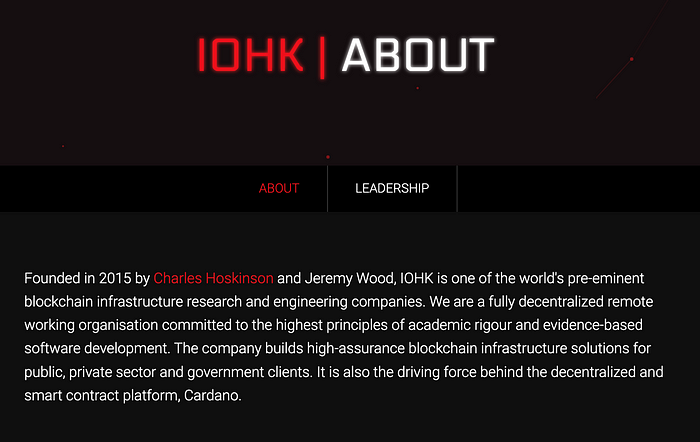
The company operates as a fully decentralized remote working organization, with a global team of over 400 people across more than 50 countries.
This diverse team brings together different skill sets, cultural perspectives, and life stages, enriching the company’s culture and enhancing its global impact.
The Driving Force Behind Cardano
IOHK is not just a research and engineering company but also the driving force behind Cardano, a decentralized cryptocurrency and smart contract platform.
Cardano is a testament to IOHK’s commitment to building high-assurance blockchain infrastructure solutions for the public, private sector, and government clients.
The Principle of Cascading Disruption
At the core of IOHK’s philosophy is the concept of “cascading disruption.”
This idea posits that most structures that form the world’s financial, governance, and social systems are inherently unstable. As such, minor perturbations can cause a ripple effect that fundamentally reconfigures the entire system.
IOHK is committed to identifying and developing technology to force these perturbations, pushing towards a more fair and transparent order. It’s a bold and ambitious mission that IOHK is uniquely positioned to undertake.
This mission is not just about disrupting existing systems but about building new ones that are more equitable, transparent, and efficient. It’s about leveraging the power of blockchain technology to create a world where a select few do not control the flow of ideas and value but is accessible to all.
Looking Ahead: The Future of IOHK
IOHK’s mission becomes even more critical as we look to the future.
The need for transparent, secure, and equitable systems becomes more urgent as the world becomes increasingly digital.
IOHK, with its commitment to academic rigor, evidence-based software development, and cascading disruption, is poised to lead the charge in this new digital frontier.
Learn More and Stay Tuned
IOHK is more than just a company; it’s a movement.
It’s a collective of individuals worldwide committed to using technology to create a more fair and transparent world. Whether you’re a blockchain enthusiast, a tech-savvy individual, or just someone interested in the future of our digital world, IOHK is a company worth watching.
Remember, the future is not something that happens to us.
It’s something we create.
With companies like IOHK leading the charge, we can create a technologically advanced, equitable, and transparent future.
So, let’s seize that opportunity, be part of the change and create the future.
Let’s not waste that chance.
Connect With IOHK
IOHK is a premier blockchain infrastructure research and engineering company, and the driving force behind the Cardano ecosystem. With a commitment to academic rigor, evidence-based software development, and cascading disruption, IOHK is shaping the future of digital systems towards a more connected, transparent, and fair configuration.
IOHK is also an exhibitor at Rare Evo, the premier blockchain and cryptocurrency conference bringing Web3 to the Rockies. Merging business and pleasure in a luxurious environment, IOHK’s participation in Rare Evo underscores the company’s commitment to being an active player in the blockchain ecosystem and beyond.
To stay updated with the latest news and developments, you can follow IOHK on various social media platforms. Connect with them on Twitter for real-time updates, join the professional network on LinkedIn, or subscribe to their YouTube channel for informative videos. You can also like their Facebook page, follow their Instagram for behind-the-scenes content, check out their code on GitHub, or join the conversation on Reddit and Telegram.
About The Rare Network
The Rare Network is a dynamic and growing organization that bridges the gap between traditional industry and emerging blockchain technology.
Our flagship event, Rare Evo, is the premier blockchain conference that brings together multi-chain projects, industry leaders, investors, and enthusiasts.
Rare Evo isn’t just a convention. It’s an immersive experience set in Denver, Colorado. We’ve got everything from educational sessions and networking opportunities to interactive experiences and live entertainment.
Hosted at the stunning Gaylord Rockies Resort, our luxurious and family-friendly venue ensures there’s something for everyone.
Don’t miss out on this game-changing event!
Buy your tickets, book your hotel room, and join the Web3 revolution.
Remember to stay connected with us on Twitter, YouTube, and Discord for the latest updates.