#Visa
Coinbase, Visa, Stripe Join Consortium to Build OpenUSD Stablecoin

Coinbase, Visa, and Stripe have joined the Open Standard consortium, which comprises more than 140 companies working to support the development of the OpenUSD (OUSD) stablecoin.

Announced on June 30, 2026, OpenUSD (OUSD) is a United States dollar-pegged stablecoin developed by Open Standard, a consortium that includes BlackRock, Google, Ripple, Solana, Aave, and more than 140 companies.
Although the OpenUSD token has not yet launched, it is expected to go live later this year. According to the core development team, the OUSD stablecoin will be backed on a one-to-one basis by the United States dollar and U.S. Treasuries. Because it is designed to scale, businesses can mint and redeem the stablecoin at no cost, with no volume caps for founding partners.
"Existing stablecoins have great strengths, but to use them at scale, businesses need something that is open, low cost, high throughput, broadly accessible, and aligned with their interests," Open Standard CEO Zach Adam said.
"We are thrilled to bring together more than 140 businesses to launch OpenUSD. It is a stablecoin built for the internet economy and designed by the businesses growing it."
Another distinguishing feature of the OpenUSD stablecoin is its shared yield model. After the operating costs of running the stablecoin infrastructure are deducted, users and participants will share almost all of the earnings generated from the stablecoin's reserves based on network activity.
Shortly after the announcement of the OpenUSD stablecoin, Circle's CRCL stock fell more than 16%, with many analysts attributing the decline to the launch of OUSD. Despite the sharp drop, Circle CEO Jeremy Allaire welcomed competition in the stablecoin sector, saying that USDC remains the most widely adopted stablecoin for institutional use while reiterating the company's expansion plans. Tether CEO Paolo Ardoino also welcomed the launch of OUSD in a post on X, saying, "Player 2 has entered the game."
Visa Partners With WeFi to Enable Crypto Payments

Global payments giant Visa has partnered with the decentralized onchain bank WeFi to enable crypto based payments while allowing users to maintain full custody of their digital assets.
The partnership will initially focus on exploring ways in which WeFi’s onchain banking infrastructure can be leveraged to scale stablecoin based payments in selected markets.

“As interest in digital assets grows, our focus is on making these new models practical at scale by connecting them to payment experiences people already trust,” Mathieu Altwegg, Visa’s Head of Product and Solutions in Europe, said. “This collaboration demonstrates how Visa’s global network interacts with onchain models.”
The partnership is significant as it represents a shift in custodial practices, where users often hand over their digital assets to cryptocurrency exchanges. Since WeFi offers self custody, users will be able to maintain full control of their assets while leveraging Visa’s global payment rails and using digital assets to make payments anywhere Visa is accepted.
The rollout will take place one region at a time, with Europe, Asia, and Latin America among the first beneficiaries, while expansion continues into additional markets depending on regulatory approvals and partnerships.
“People expect money to work seamlessly across borders without unnecessary complexity. We see this partnership as a way to work with Visa’s capabilities as we continue to develop WeFi’s debanking offering across key regions,” said Maksym Sakharov, WeFi co founder and CEO.
What is WeFi?
WeFi is a blockchain based decentralized on chain bank (deobank) founded by Maksym Sakharov and Reeve Collins, a co founder of Tether.
Through its mobile first, simple interface, WeFi provides financial services to more than 1.4 billion unbanked people worldwide, allowing them to maintain full custody of their digital assets while facilitating crypto based payments and cross border transfers.
Since its launch last year, WeFi has grown significantly, serving more than 150,000 users across over 80 countries. To support crypto based payments, WeFi has partnered with industry players including LayerZero and has announced integrations with companies such as Binance and Visa.

Western Union to Launch USDPT Stablecoin on Solana

Global financial services company Western Union has announced its plans to launch its long awaited U.S. Dollar Payment Token (USDPT) stablecoin next month.
The Solana based USDPT stablecoin, which is to be issued by crypto bank Anchorage Digital, is already in its final stages of preparation and is expected to launch, Devin McGranahan, Western Union CEO and President, revealed during the firm’s recent first quarter earnings call.
"It is no longer a question of if Western Union will be active in digital assets; it is now how fast we can scale," McGranahan said during the call with investors and financial analysts.
McGranahan also revealed in a Q&A session that the USDPT stablecoin will not be launched as a consumer product, but will instead initially be used internally as an alternative to the SWIFT network. With the USDPT stablecoin, Western Union aims to facilitate fast transaction settlements in real time with its agents around the world.
Other Services to Be Launched Alongside USDPT
Alongside the USDPT stablecoin, Western Union will be launching two additional services and products: its USD stablecard and the Digital Asset Network, or DAN, which allows digital assets, including USDPT and crypto wallets, to connect with Western Union’s existing infrastructure.
By means of a single connection to Western Union’s API, DAN provides off ramp services to users, enabling them to convert stablecoins held in crypto wallets into local currencies.
"Through DAN, millions of wallet users will be able to move from digital assets into local currency using Western Union's retail network, with an experience that is simple for customers and familiar for our agents," McGranahan said, while also stating that the first partner of the network will be revealed next week. DAN will be made available in over 360,000 locations across more than 200 countries and territories.
To allow users to hold value in stablecoins, including USDPT, Western Union will also be launching its USD stablecard, a consumer based card developed by crypto wallet provider Rain and Visa.
The stablecard, according to McGranahan, will be especially compelling in inflation sensitive markets where customers want dollar denominated value, and it will be launched across dozens of markets worldwide. With the card, users living in areas hit by high inflation will be able to hold USD based stablecoins and spend them globally.

Visa Joins Tempo Blockchain as Validator Node

Global payments giant Visa has launched a validator node on Tempo’s Layer 1 blockchain network, enabling it to participate directly in the verification and processing of transactions on the network.
The validator role follows a six month collaboration between Visa and Tempo’s engineering team, which worked to integrate Visa’s secure infrastructure into the Tempo network. According to Visa, the validator will be configured and managed in house.
With the integration of Visa’s infrastructure into the Tempo network, Visa joins Stripe and Zodia Custody as the first external validators to verify and process transactions on the Tempo blockchain, with more validators expected in the future.

Since Visa processes billions of transactions globally, its role as an anchor validator places it in a crucial position in securing Tempo’s blockchain and strengthening its resilience, reliability and performance for stablecoin payment use cases.
Speaking on the collaboration, Cuy Sheffield, head of crypto at Visa, said the move highlights Visa’s role in supporting the development of stablecoin payment systems and its commitment to reliability, security, and trust in blockchain networks.
What is Tempo Layer-1 Blockchain?
Tempo is a purpose-built Layer 1 blockchain designed for large-scale stablecoin payments and other real-world financial applications. Although Tempo was initially incubated by Stripe and the crypto venture capital firm Paradigm, it became an independent company with its own team, Tempo Labs, in September 2025.
Unlike most Layer 1 blockchains, which are designed for general-purpose decentralized finance activity, the Tempo blockchain was designed for fast, low-cost, and reliable stablecoin transfers that traditional blockchains often struggle to support under high load.
The Tempo blockchain was also designed for agentic and machine-to-machine commerce. Through Stripe’s Machine Payments Protocol (MPP), the Tempo network enables autonomous AI agents to make payments and conduct other real-world commerce activities without human intervention.
Visa Intensifies Push for Blockchain Adoption
Visa remains one of the few traditional finance (TradFi) giants spearheading global adoption and integration of blockchain technology into TradFi payment infrastructure. Similar to its most recent Tempo validator role, in March of this year, Visa became the first major payment company to serve as a super validator on Canton Network, a privacy-focused institutional blockchain network, with plans to also become one of the validators on Circle’s Arc blockchain.
It has also expanded its push for blockchain-based payments, including the launch of USDC settlement on Solana for US residents, enabling support for four stablecoins on its platform, and powering over 130 stablecoin card programs in more than 40 countries.

Alchemy Tackles AI Payment Chaos with AgentPay

Blockchain infrastructure company Alchemy has launched AgentPay, an interoperability tool designed to enable communication between AI payment systems.
AgentPay was introduced with the goal of addressing the fragmentation that exists among AI payment agents. By unifying different payment agents regardless of the payment protocols they use, AgentPay enables agents, including those from major payment companies such as Coinbase, Stripe, Visa, and Circle, to work together and communicate with one another.
The Fragmentation Problem
There has been a shift in recent times in the way AI agents are used, with AI agents evolving from being chat assistants like ChatGPT into autonomous economic actors.
These AI agents do not only assist or provide feedback. They are able to independently discover services, compare options, negotiate, and execute payments without human intervention. This development has been described by some as the agentic commerce era.
With major technology and finance institutions such as OpenAI, Anthropic, Google, Coinbase, Stripe, Visa, Mastercard, and Circle actively developing and deploying AI agents capable of conducting real transactions, the adoption of AI in commercial activity has accelerated over the past year. Because these agents often rely on different payment protocols, communication between AI payment agents and systems can be complex.
This fragmentation, if left unresolved, could hinder the growth of businesses integrating AI into their platforms. Analysts project that up to 90 percent of business-to-business purchases could be facilitated by AI agents by 2028, making compatibility with AI agents increasingly important for businesses, regardless of the underlying protocol used by the agent.
If an AI agent is not compatible with a business’s application programming interface (API) or service, it may simply move on to another platform that is compatible. In this environment, the most compatible platform may gain a significant advantage. This challenge is what Alchemy’s AgentPay aims to address.

Image credit: Alchemy
Instead of requiring businesses to build separate integrations for every protocol used by AI agents, businesses can register their existing application programming interface endpoints with Alchemy. After that, AgentPay generates a proxied endpoint, which is a single, uniform URL that AI agents can use to make payments regardless of the protocol they use, including x402, MPP, A2P, or L402.
x402 Foundation Launches Under Linux Foundation

The internet has always had a payments problem. HTTP moved data. SMTP moved email. But money? Money got stuck behind proprietary rails, bank integrations, and checkout forms that were never really built for a digital-first world. That gap, which the industry has spent decades papering over with varying degrees of success, is now the target of something bigger than any one company: the x402 Foundation, launched today under the Linux Foundation, with Coinbase, Cloudflare, and Stripe among its founding backers.
The announcement, timed to April 2 (a nod to HTTP status code 402, "Payment Required"), marks a formal step toward turning x402 into a neutral, community-governed standard. And the list of companies signing on makes it hard to dismiss as just another crypto lab experiment. Adyen, Amazon Web Services, American Express, Ant International, Google, Mastercard, Microsoft, Shopify, the Solana Foundation, Visa, and more than a dozen other names from across fintech, big tech, and crypto all attached their names to the effort.
What x402 Actually Does
The protocol is simple. When a client tries to access a resource gated behind x402, the server responds with the 402 Payment Required status code along with machine-readable payment instructions: amount, asset, network, recipient. The client then attaches a payment authorization header and resends the request. A facilitator verifies the payment and settles the transaction. That is the whole flow. No accounts, no subscriptions, no API keys, no manual billing cycles.
Coinbase launched the first version in May 2025, quietly, with the 402 HTTP status code having sat largely dormant since it was first defined in the early 1990s. Within months the protocol had processed over 100 million payments across APIs, apps, and AI agents. By December, the team shipped x402 V2, which added multi-chain support by default, cleaner separation between clients, servers, and facilitators, and the architectural foundations for session management and identity. The reference SDKs are available across TypeScript, Go, and Python.
Transaction costs sit near zero, with Coinbase's facilitator offering the first 1,000 transactions per month free and charging $0.001 per transaction beyond that. For micropayments, the kind worth a fraction of a cent that credit card networks have never handled well, that matters enormously. The protocol currently runs on Base, Polygon, and Solana, with stablecoins like USDC as the primary settlement layer. Future versions are designed to accommodate traditional rails as well, including ACH, SEPA, and card networks, using the same payment model.
Why This Moment, Why This Structure
The timing is not accidental. The push into autonomous AI agents across the industry has exposed a glaring problem: agents need to pay for things. When an AI assistant browses the web to buy something, or a trading bot needs a real-time data feed, or a robot needs to procure compute on the fly, making a human stop and authorize each payment defeats the entire point. What the industry needs is a payment primitive that works the way HTTP works: in the background, at machine speed, without friction.
"The internet was built on open protocols," said Jim Zemlin, CEO of the Linux Foundation, in comments tied to the launch. The Foundation's involvement is a deliberate move to ensure no single company ends up owning the payment layer of the agentic web. Cloudflare CEO Matthew Prince echoed that logic in September when the two companies announced their intent to launch the Foundation together: the internet's core protocols have always been governed independently, and x402 should be no different.
That governance structure is a meaningful part of the pitch. The x402 Foundation is framed explicitly as stewardship, not ownership. No single company controls the standard. The membership body is open to developers, startups, and enterprises. Cloudflare's alignment with the effort also signals that x402 is being treated as infrastructure at the edge level, not just a crypto developer toy. Integrating x402 into Cloudflare's edge compute and CDN stack means payment requests can slot into everyday web workflows the same way SSL became table stakes for basic security.
The Bigger Picture
Early use cases already live in production. Hyperbolic, an AI compute marketplace, uses x402 for AI agents paying per GPU inference session rather than committing to a monthly subscription. OpenMind has robots autonomously procuring compute and data. Cal.com embeds x402 for paid human interactions directly inside scheduling workflows. The scope of what a frictionless pay-per-use primitive unlocks is genuinely wide, and that is before the protocol adds broader identity support and more payment backends.
There are real risks worth naming. The protocol currently leans heavily on Coinbase's own facilitator infrastructure, which handles verification and settlement and is, today, the most mature option in the ecosystem. Cloudflare and others reduce protocol-level concentration, but early traffic still routes largely through Coinbase's stack. The facilitator is free now. That may not last indefinitely once network effects solidify. And unlike credit card networks, x402 has no network-level payment reversal. Refunds require a compensating transfer from the merchant, making the protocol closer to cash than to a reversible card transaction. For high-frequency API calls that is a feature. For consumer flows that expect buyer protections, it is a liability worth monitoring.
What x402 has going for it, beyond the technical architecture, is the coalition. Visa and Mastercard alongside the Solana Foundation and Polygon Labs in the same founding member list is unusual. Google Cloud's managing director for Web3 and Digital Assets called the shift toward agentic commerce a fundamental reason Google is joining, describing the need for cloud infrastructure that is as open as the protocols it supports. Whether that breadth translates into real interoperability or remains aspirational will be one of the defining stories to watch as the Foundation gets off the ground. If x402 does become foundational plumbing, the question will be who benefits most from having been at the table when the standard was written.
Stablecoin Payments Firm Rain Hits $1.95B Valuation in Major Funding Round
Rain’s Big Raise Signals Stablecoins Are Moving Toward Everyday Money

Rain just raised $250 million at a valuation just shy of $2 billion, and the size of the round is only part of the story.
What really stands out is what investors are backing. This is not a bet on a new token, a trading platform, or a speculative crypto narrative. It’s a bet that stablecoins are quietly becoming part of the global payments system, and that Rain is positioning itself as one of the companies building the pipes.
For years, stablecoins have been treated as a behind-the-scenes tool for traders and crypto-native users. Rain is trying to move them out of the background and into everyday spending.
What Rain Actually Builds
Rain describes itself as stablecoin payments infrastructure, but in practice, it operates more like a full-stack payments company.
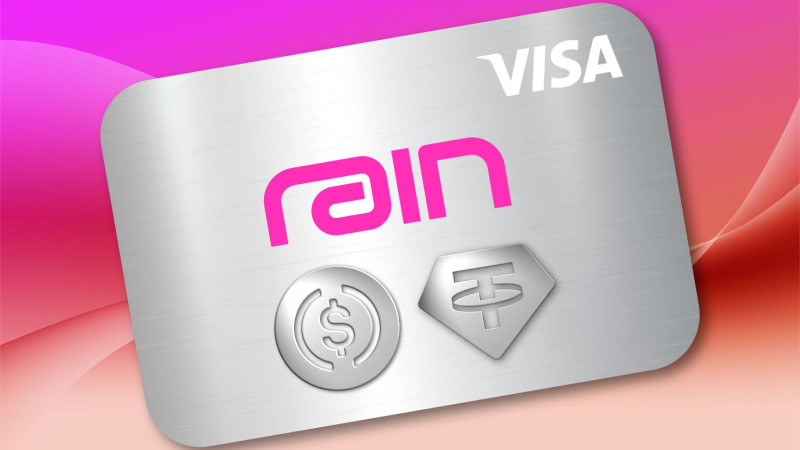
The platform allows partners to issue payment cards that are directly connected to stablecoin balances. Those cards can be used anywhere Visa is accepted, which immediately changes how practical stablecoins become for everyday use. From the user’s perspective, it looks and feels like a normal card transaction. Under the hood, the value is settled using stablecoins.
Rain also provides wallets, on- and off-ramps, compliance tooling, and APIs that enterprises can plug into. The goal is to let fintechs, crypto companies, and global platforms launch stablecoin-based payment products without having to build payments infrastructure from scratch.
This setup is already live across more than 150 countries, giving Rain a global footprint that goes well beyond experimental pilots.
The Visa Connection Is a Big Part of the Story
One of the reasons Rain stands out is its direct relationship with Visa.
Rain is a Visa principal member, which means it can issue cards directly on the Visa network rather than relying on third-party sponsors. That status is not trivial. It places Rain closer to traditional payments infrastructure while still operating on crypto rails.
Even more important is how settlement works. Rain has been involved in Visa’s move toward stablecoin settlement, allowing card transactions to be settled on chain using stablecoins rather than relying entirely on legacy banking settlement systems. That opens the door to faster settlement cycles, including weekends and holidays, and reduces some of the friction that exists in traditional cross-border payments.
In simple terms, Visa handles the merchant acceptance and point-of-sale experience. Rain handles the stablecoin side of the transaction. Together, they create something that looks familiar to users but operates very differently in the background.
Why Investors Are Paying Attention
Rain’s growth metrics look more like a payments company than a typical crypto startup.
The company reports billions of dollars in annualized transaction volume, rapid growth in active cards, and a growing list of enterprise partners using its infrastructure to launch payment programs. That traction helps explain why investors were willing to price the company near $2 billion in this round.
The investor roster also tells a story. The round was led by a major growth firm, with participation from both traditional venture capital and crypto-focused investors. That mix suggests Rain is being viewed as a bridge company, one that sits between fintech and crypto rather than fully in either camp.
The fresh capital is expected to support expansion into new markets, deeper enterprise integrations, and continued investment in compliance and licensing, which remain critical for any payments business operating at global scale.
Stablecoins Are Shifting From Trading Tools to Payment Rails
Rain’s rise comes as stablecoins themselves are going through a quiet identity shift.
They still play a major role in trading and on-chain finance, but more companies are now looking at them as a way to move dollar-like value globally with fewer intermediaries. The challenge has always been usability. Most people do not want to think about wallets, gas fees, or blockchain confirmations when they pay for something.
Rain’s model hides that complexity. Users swipe a card. The merchant gets paid. The settlement happens using stablecoins in the background.
That approach aligns with a broader trend across payments and fintech, where blockchain is increasingly treated as infrastructure rather than a product in itself.
A Competitive Landscape and Real Execution Risk
None of this guarantees success.
The space is getting crowded. Other crypto infrastructure companies are building similar tools, and large fintechs and banks are experimenting with stablecoin settlement of their own. Regulatory frameworks are evolving, but uncertainty still exists, especially across jurisdictions.
Rain’s challenge now is execution. Scaling payments infrastructure is hard. Doing it globally, while staying compliant and reliable, is even harder. The Series C gives Rain the resources to try, but the next phase will be about proving that stablecoin-powered payments can move from niche programs to mainstream usage.
Why This Matters
Rain’s funding round is a signal that the crypto market’s focus is shifting again.
Not toward speculation, but toward utility. Not toward flashy narratives, but toward infrastructure that quietly connects crypto to the real economy.
If stablecoins are going to become everyday money, they will need to work through systems people already trust and understand. Rain’s partnership with Visa, and its push to make stablecoin settlement invisible to users, suggests one possible path forward.
That makes this raise more than just another big crypto funding headline. It marks a moment where stablecoins start to look less like an experiment and more like a serious part of the global payments conversation.
Stay Connected
You can stay up to date on all News, Events, and Marketing of Rare Network, including Rare Evo: America’s Premier Blockchain Conference, happening July 28th-31st, 2026 at The ARIA Resort & Casino, by following our socials on X, LinkedIn, and YouTube.