#protocol
x402 Foundation Launches Under Linux Foundation

The internet has always had a payments problem. HTTP moved data. SMTP moved email. But money? Money got stuck behind proprietary rails, bank integrations, and checkout forms that were never really built for a digital-first world. That gap, which the industry has spent decades papering over with varying degrees of success, is now the target of something bigger than any one company: the x402 Foundation, launched today under the Linux Foundation, with Coinbase, Cloudflare, and Stripe among its founding backers.
The announcement, timed to April 2 (a nod to HTTP status code 402, "Payment Required"), marks a formal step toward turning x402 into a neutral, community-governed standard. And the list of companies signing on makes it hard to dismiss as just another crypto lab experiment. Adyen, Amazon Web Services, American Express, Ant International, Google, Mastercard, Microsoft, Shopify, the Solana Foundation, Visa, and more than a dozen other names from across fintech, big tech, and crypto all attached their names to the effort.
What x402 Actually Does
The protocol is simple. When a client tries to access a resource gated behind x402, the server responds with the 402 Payment Required status code along with machine-readable payment instructions: amount, asset, network, recipient. The client then attaches a payment authorization header and resends the request. A facilitator verifies the payment and settles the transaction. That is the whole flow. No accounts, no subscriptions, no API keys, no manual billing cycles.
Coinbase launched the first version in May 2025, quietly, with the 402 HTTP status code having sat largely dormant since it was first defined in the early 1990s. Within months the protocol had processed over 100 million payments across APIs, apps, and AI agents. By December, the team shipped x402 V2, which added multi-chain support by default, cleaner separation between clients, servers, and facilitators, and the architectural foundations for session management and identity. The reference SDKs are available across TypeScript, Go, and Python.
Transaction costs sit near zero, with Coinbase's facilitator offering the first 1,000 transactions per month free and charging $0.001 per transaction beyond that. For micropayments, the kind worth a fraction of a cent that credit card networks have never handled well, that matters enormously. The protocol currently runs on Base, Polygon, and Solana, with stablecoins like USDC as the primary settlement layer. Future versions are designed to accommodate traditional rails as well, including ACH, SEPA, and card networks, using the same payment model.
Why This Moment, Why This Structure
The timing is not accidental. The push into autonomous AI agents across the industry has exposed a glaring problem: agents need to pay for things. When an AI assistant browses the web to buy something, or a trading bot needs a real-time data feed, or a robot needs to procure compute on the fly, making a human stop and authorize each payment defeats the entire point. What the industry needs is a payment primitive that works the way HTTP works: in the background, at machine speed, without friction.
"The internet was built on open protocols," said Jim Zemlin, CEO of the Linux Foundation, in comments tied to the launch. The Foundation's involvement is a deliberate move to ensure no single company ends up owning the payment layer of the agentic web. Cloudflare CEO Matthew Prince echoed that logic in September when the two companies announced their intent to launch the Foundation together: the internet's core protocols have always been governed independently, and x402 should be no different.
That governance structure is a meaningful part of the pitch. The x402 Foundation is framed explicitly as stewardship, not ownership. No single company controls the standard. The membership body is open to developers, startups, and enterprises. Cloudflare's alignment with the effort also signals that x402 is being treated as infrastructure at the edge level, not just a crypto developer toy. Integrating x402 into Cloudflare's edge compute and CDN stack means payment requests can slot into everyday web workflows the same way SSL became table stakes for basic security.
The Bigger Picture
Early use cases already live in production. Hyperbolic, an AI compute marketplace, uses x402 for AI agents paying per GPU inference session rather than committing to a monthly subscription. OpenMind has robots autonomously procuring compute and data. Cal.com embeds x402 for paid human interactions directly inside scheduling workflows. The scope of what a frictionless pay-per-use primitive unlocks is genuinely wide, and that is before the protocol adds broader identity support and more payment backends.
There are real risks worth naming. The protocol currently leans heavily on Coinbase's own facilitator infrastructure, which handles verification and settlement and is, today, the most mature option in the ecosystem. Cloudflare and others reduce protocol-level concentration, but early traffic still routes largely through Coinbase's stack. The facilitator is free now. That may not last indefinitely once network effects solidify. And unlike credit card networks, x402 has no network-level payment reversal. Refunds require a compensating transfer from the merchant, making the protocol closer to cash than to a reversible card transaction. For high-frequency API calls that is a feature. For consumer flows that expect buyer protections, it is a liability worth monitoring.
What x402 has going for it, beyond the technical architecture, is the coalition. Visa and Mastercard alongside the Solana Foundation and Polygon Labs in the same founding member list is unusual. Google Cloud's managing director for Web3 and Digital Assets called the shift toward agentic commerce a fundamental reason Google is joining, describing the need for cloud infrastructure that is as open as the protocols it supports. Whether that breadth translates into real interoperability or remains aspirational will be one of the defining stories to watch as the Foundation gets off the ground. If x402 does become foundational plumbing, the question will be who benefits most from having been at the table when the standard was written.
How Should Crypto Protocols Really Create Value for Token Holders?

Crypto has never been great at answering a simple question: what do token holders actually get?
For a long time, the answer was basically “number go up.” You bought a token because you believed the protocol would matter someday, and if that happened, the token would be worth more. Sometimes much more. And you could sell those tokens to someone else who believed that same as you, just a bit later in the timeline. That was enough in a market driven by growth, hype, and reflexivity.
But, now the industry is older, and presumably more mature. DeFi protocols generate real revenue. Some of them generate a lot of it. And once real money starts flowing through systems, people start asking uncomfortable but reasonable questions. Who benefits from this? Where does the value go? And why should I hold the token instead of just trading it to the next guy?
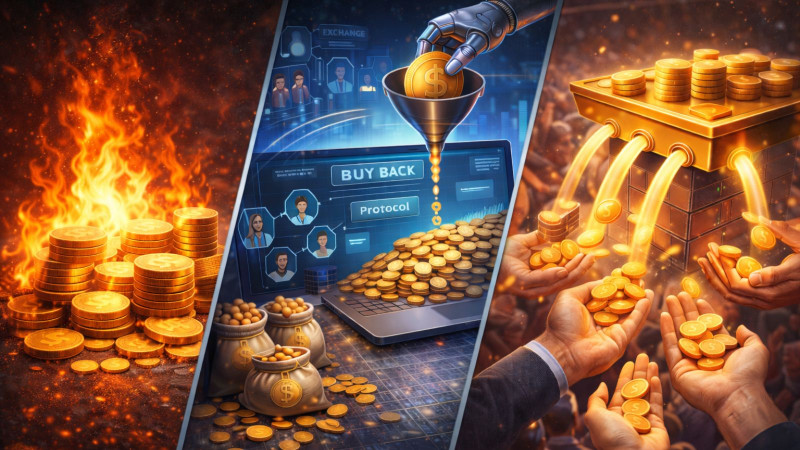
There are answers that show up again and again: burns, buybacks, and dividend-style payouts.
Each one says something different about how a protocol thinks about ownership.
The Good Old Token Burn: Familiar, Clean, and a Little Hollow
Burning tokens is crypto’s comfort food. It is simple, emotionally satisfying, and easy to explain on social media. Fewer tokens, more scarcity, higher price. Well, in theory.
And to be fair, burns can work, especially in strong markets. They create a sense of discipline. They tell holders that supply is being managed, that inflation is not running wild.
But burns do not actually give anyone anything. No cash, no yield, no participation in revenue. You are still relying on the market to do the rest of the work.
That can be fine if demand is strong. It is much less convincing when demand is uncertain. Scarcity alone does not create value, it only amplifies it if something else is already there.
Burns feel like an answer from an earlier era of crypto, when optics mattered more than fundamentals.
Token Buybacks: More Serious, Still Indirect
Buybacks feel like crypto growing up and borrowing language from public markets.
Instead of destroying tokens automatically, protocols use revenue or treasury funds to buy their own tokens on the open market. The signal is clear: the protocol believes the token is undervalued and is willing to spend real money to prove it.
That matters. Buybacks introduce actual demand. They are less abstract than burns. They also force protocols to think more carefully about treasury management and sustainability.
But at the end of the day, buybacks still work through price. If the market reacts, holders benefit. If it does not, they do not. There is no guarantee, no direct transfer of value, no moment where a holder can say, “I received this because the protocol performed well.”
In traditional finance, buybacks are often paired with dividends. In crypto, they are usually positioned as the whole story. That gap is something worth paying attention to.
Dividends and Revenue Sharing: The Awkward but Honest Option
Dividend-style payouts in crypto tend to make people uncomfortable. They feel a bit too close to traditional finance. And the instinctive reaction is usually something like, aren’t we supposed to be reinventing all of this?
In some ways, yes. There are definitely parts of the financial system that deserve to be challenged or rebuilt entirely. But that does not automatically mean everything old is useless. Some mechanisms stuck around because they solved real problems. Dividends are one of those.
At its core, the idea is pretty simple. If a protocol makes money, some of that money goes back to the people holding the token. Maybe you have to stake. Maybe you have to lock tokens for a while. Maybe the payout changes over time. The specifics can vary, but the relationship is clear enough. When the protocol does well, holders benefit.
That alone changes the dynamic. You are no longer just holding a token and hoping it becomes more desirable later. You are actually participating in the economics of the thing you own.
It also forces a kind of honesty. If revenue drops, payouts drop. If the protocol grows, holders feel it directly. There is not much room to hide behind supply tweaks or clever treasury narratives.
The objections are predictable. Regulation. Complexity. Governance risk. And to be fair, those are not imaginary concerns. Once you start sharing revenue, it starts to look a lot like ownership, and ownership comes with responsibilities that crypto has historically tried to sidestep.
But pretending that reality does not exist does not really help. And once protocols manage capital and distribute value, they are already doing financial work, whether they want to admit it or not.
Dividends do not invent that reality. They just stop dancing around it.
This Is Really About Maturity
Burns, buybacks, and dividends are not just technical choices. They are statements about what a protocol wants to be.
Burns prioritize simplicity and narrative. Buybacks prioritize signaling and market mechanics. Dividends prioritize alignment and accountability.
None of them are universally right or wrong. Early-stage protocols probably should not be paying out revenue. Infrastructure layers may prefer reinvestment. Some tokens are governance tools first and economic assets second.
But as DeFi matures, it is becoming harder to justify tokens that never touch the value they help create.
At some point, holders stop asking how clever the tokenomics are and start asking a simpler question: what do I get if this works?
Crypto does not need to become traditional finance. But it probably does need to answer that question more directly. Whether that leads to dividends, something like them, or an entirely new model is still open.
But what is beginning to feel increasingly outdated is pretending that question does not matter.
Stay Connected
You can stay up to date on all News, Events, and Marketing of Rare Network, including Rare Evo: America’s Premier Blockchain Conference, happening July 28th-31st, 2026 at The ARIA Resort & Casino, by following our socials on X, LinkedIn, and YouTube.