#OKX
OKX Launches Exchange OS on X Layer for On-Chain Markets

Cryptocurrency exchange OKX has launched Exchange OS, a major protocol upgrade built on X Layer, its EVM-compatible Layer 2 network, allowing developers, institutions, and ecosystem participants to create spot, perpetual, and outcome markets.

Exchange OS is designed to address fragmented infrastructure, one of the biggest obstacles limiting the expansion and adoption of on-chain finance.
“While blockchain enabled open asset issuance, the infrastructure for trading, settlement, margining, and liquidity remains siloed across disconnected venues and applications,” Star Xu wrote in a blog post. “Builders still face the same tradeoff: rely on centralized infrastructure or rebuild complex exchange systems from scratch,” he added.
By launching Exchange OS, OKX aims to create a shared market infrastructure that enables developers and institutions to launch new trading experiences efficiently while maintaining flexibility in core areas, including risk controls, compliance, market structure, and frontend design.
Exchange OS moves core exchange functions, including matching, margining, liquidation, settlement, and risk management, to the protocol layer of X Layer, creating a shared execution environment that allows developers to build different types of markets within a single environment.
Using the configurable components of Exchange OS infrastructure, developers and institutions can create trading venues, or marketplaces where trading takes place. As a result, Exchange OS enables developers to build customized trading platforms.
With Exchange OS, users can deploy trading venues permissionlessly via the X Layer Improvement Proposal for Exchange OS (XIP Exchange OS), choosing their own assets, oracle systems, revenue models, and compliance frameworks without requiring approval from a centralized entity. Regulated institutions can also launch fully KYC-compliant trading platforms.
Exchange OS also serves traders by enabling a unified account and margin system across spot, perpetual, and outcome markets, allowing capital to move seamlessly between markets rather than being trapped across fragmented platforms.
OKX to Debut Trading Venue on Exchange OS
To demonstrate its commitment to the newly launched Exchange OS platform, OKX will launch the first trading venue on Exchange OS.
“In June, we will launch the 2026 World Cup Outcomes, a simulated outcome market deployed directly on the infrastructure. We wanted to build on the system ourselves before opening it more broadly because the best way to demonstrate open market infrastructure is to use it in production first,” OKX said in a blog post.
OKX Eyes Coinone Stake as Crypto M&A Boom Accelerates

Global cryptocurrency exchange OKX and Korea Investment & Securities are reportedly looking to acquire approximately 20% stakes each in Coinone, a cryptocurrency exchange based in South Korea.
To maximize capital flow, the acquisition will involve Coinone issuing new equity shares to OKX and its acquisition partner, rather than selling shares held by existing shareholders. Although the acquisition is, for now, just a financial investment, some industry observers have opined that OKX may become more involved in the exchange’s managerial activities in the future.
Currently, The One Group, a private investment company managed by Cha Myung hoon, Coinone’s founder, owns about 34.30% of Coinone, followed by Com2uS Holdings, a South Korean gaming firm, which owns 21.95%, and Com2uS Plus, one of its entities, which owns 16.47 percent. Coinone's CEO, Cha Myung-hoon, owns 19.14%.
If successful, this will be the third time a global cryptocurrency exchange has acquired a stake in a South Korean exchange. In 2022, crypto exchange Crypto.com fully acquired OK BIT, a small South Korean crypto exchange, while in 2025, Binance acquired a 67% majority stake in Gopax, one of South Korea’s top five crypto exchanges.
Crypto Acquisitions on the Rise
The partial acquisition of Coinone by OKX comes at the same time as Hana Bank, one of South Korea’s largest commercial banks, announced a 6.55% stake acquisition in Dunamu, the parent company of Upbit, the largest cryptocurrency exchange in South Korea.
Kraken, through its parent company Payward, has also agreed to acquire Reap, a payments infrastructure firm based in Hong Kong, for about $600 million, just a few weeks after it acquired Bitnomial for $550 million in April.
Several other crypto entities have also been involved in acquisitions, including the crypto exchange Bullish, which acquired Equiniti for $4.2 billion, and MoonPay, which recently acquired Dawn Labs.
According to a report from Architect Partners, about 89 crypto acquisition deals were completed in the previous quarter, with approximately $3.2 billion spent on crypto-related acquisitions, a significant increase from the first quarter of 2025, which recorded 61 deals and $2.2 billion in deal value.
OKX Launches AI Agent Payments Protocol for Crypto Commerce

Cryptocurrency exchange OKX has launched Agent Payments Protocol (APP), a new payment protocol that allows AI agents to perform commercial activities.
The new payment protocol, according to OKX, is an open standard that defines how AI agents communicate and negotiate, pay for services, and pay each other. It also, for the first time, allows AI agents to move beyond simple payments and into full-scale commerce.

“In the past few months, AI agents moved from answering questions to running workflows, managing business processes, and acting autonomously on behalf of users,” OKX wrote in a blog post. “The bottleneck shifted from intelligence to commerce - not just paying, but the full cycle of doing business: quoting, negotiating, escrowing funds, metering usage, settling, and resolving disputes.”
This existing problem among AI agents is what OKX aims to solve with its new Agent Payments Protocol (APP), allowing agents not only to manage single payment requests but also to manage payment requests across multiple levels.
Inside the Agent Payment Protocol
The agent payment protocol (APP) from OKX is an open standard designed to work across all chains, especially the Solana and Ethereum blockchains.
APP unlocks new capabilities for AI agents, making it possible for these agents to operate and communicate autonomously across the full commerce lifecycle, pay each other through agent-to-agent payments, and also allowing AI agents to perform upfront and top-up payments, including deductions.
At its implementation layer is the payment software development kit (SDK) that makes it possible for developers to accept and make agent payments with just a few lines of code. According to the blog announcement, the agent payment protocol supports a wide variety of payments, including one-time payments, batch payments, pay-as-you-go, and escrow payments, which OKX says is coming soon.
Embedded within the payment protocol is the OKX self-custodial agentic wallet, which supports over 20 blockchains. Since the wallet is secured by means of a Trusted Execution Environment (TEE), a hardware-based security environment, the wallet’s private keys and sensitive operations are kept highly secure.
Despite its early launch, the OKX agent payment protocol is currently supported by major cloud infrastructure firms, including Amazon Web Services (AWS) and Alibaba Cloud, as well as blockchain companies such as Uniswap, Paxos, MoonPay, Zerion, and Nansen.
With the launch of its payment protocol, OKX joins companies such as Coinbase, Stripe, and OpenAI, which have already launched their payment protocols, namely x402, Agentic Commerce Protocol (ACP), and Machine Payments Protocol (MPP), respectively.
Aave Launches on OKX X Layer, Expands DeFi Access

Aave, the leading decentralized lending protocol, has launched on X Layer, an Ethereum-based layer-2 blockchain network developed by cryptocurrency exchange OKX.
The launch, which took place on Monday, March 30, saw Aave v3 integrated onto X Layer. The integration is intended to expand decentralized finance (DeFi) accessibility while also supporting the growth of the X Layer ecosystem, positioning OKX further as a DeFi hub.
Launched in 2024 by OKX, X Layer is a layer-2 blockchain built on top of Ethereum. It is designed to enable faster, lower-cost, and more scalable transactions compared to the Ethereum mainnet.

Rather than processing all transactions directly on Ethereum, which can be slower and more expensive, X Layer processes transactions off-chain before settling them on Ethereum.
According to OKX, the network can handle transactions at an average cost of approximately $0.0005, with processing times of around 0.4 seconds. It also uses zero-knowledge (ZK) technology to verify transactions while preserving data privacy.
The integration of Aave with X Layer is expected to enable DeFi users to conduct activities within the OKX ecosystem, including lending and borrowing crypto assets and earning yields, without relying on cross-chain bridges or additional DeFi infrastructure.
Although X Layer currently has relatively low total value locked (TVL), at around $25 million, more than 100 DeFi platforms have integrated with the network, including Aave, Uniswap, and Chainlink for oracle services.
The integration of Aave into OKX’s X Layer is seen as a step toward bridging centralized exchanges (CEXs) and decentralized finance, potentially expanding access to DeFi services for OKX users. According to reports, X Layer has also seen a 20% increase in user activity following Aave’s integration.
Aave v4 Launch
The integration of Aave into X Layer comes amid the launch of Aave v4, which went live on Ethereum on March 30.
Aave v4 introduces a “hub-and-spoke” architecture in which liquidity is organized into hubs connected to multiple markets. The design aims to improve capital efficiency and interoperability, and it expands the protocol’s capabilities to support additional lending types, including fixed-rate lending and real-world asset (RWA) collateral.
Aave is currently the largest decentralized lending protocol, with cumulative lending volume exceeding $1 trillion, total value locked (TVL) of approximately $23.9 billion, and 24-hour trading volume of around $179 million.
OKX Launches Built-In DEX Trading Across Base, Solana and X Layer
OKX Launches Unified DEX Trading for Base, Solana and X Layer
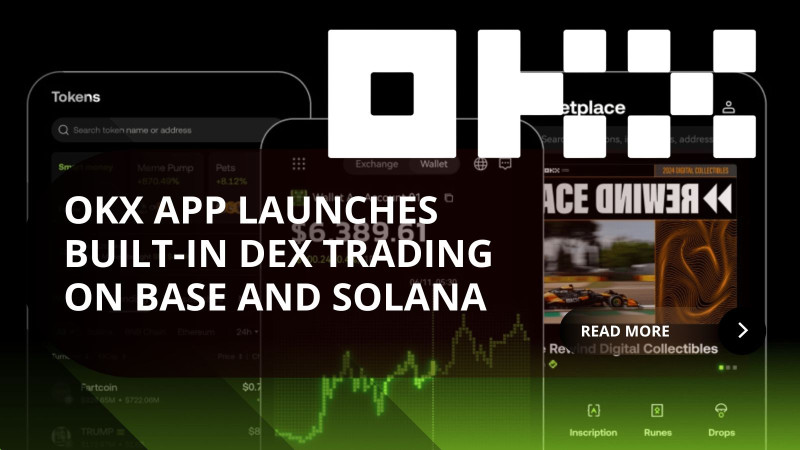
The global crypto exchange OKX has introduced a major upgrade to its app that integrates decentralized exchange (DEX) trading across multiple chains: Base, Solana and its own X Layer network. Users can now execute decentralized trades inside the OKX mobile application, enabling both centralized and decentralized trading from a single interface.
This move signals a new phase of centralized exchanges embracing DeFi liquidity rather than competing against it.
Unified interface for CEX and DEX
OKX’s update allows users to shift seamlessly between centralized order-books and on-chain markets. The wallet automatically sets up a self-custody passkey wallet when DEX mode is activated, ensuring users retain control of private keys while trading decentralized liquidity.
Liquidity is aggregated from more than 100 pools across supported chains, enabling the app to route orders toward the best available price.
Multi-chain support: Base, Solana and X Layer
-
On Base the integration taps into the growing ecosystem of Web3 apps building on its Ethereum-compatible roll-up.
-
On Solana the feature connects to high-performance on-chain DEXs that specialize in ultra-low fees and high throughput.
-
On X Layer OKX’s own modular Layer-2 supports EVM equivalence, throughput of several thousand transactions per second and is positioned to be a key part of OKX’s future modular infrastructure.
Self-custody meets exchange convenience
OKX emphasizes that users retain full self-custody of the DEX trades while benefiting from the liquidity and user-experience of a large exchange. For many retail users this removes the friction of switching between wallet apps, bridges and trading venues.
Lowering friction between CEX and DeFi
Historically traders faced two worlds: centralized exchanges (fast, liquid, custodial) and decentralized exchanges (non-custodial, self-sovereign, often clunkier). OKX’s integration helps bridge that divide. By offering both modes in one app it reduces switching cost and increases accessibility to on-chain markets.
Supporting multi-chain adoption
By including Base, Solana and X Layer networks OKX is betting that multi-chain strategies will dominate Web3. Users can access tokens, swaps and liquidity beyond a single network and participate in ecosystems that specialize in performance, low cost and innovation.
Strategic advantage for OKX
For OKX this feature furthers differentiation. Many exchanges now support wallet-apps, but fewer integrate full DEX trading across major chains inside their main app. OKX’s move could drive retention, user growth and stronger positioning in both CEX and DeFi sectors.
The broader context in DeFi evolution
Decentralized exchange volumes recently reached record highs with monthly totals exceeding $600 billion. The early DeFi wave emphasized pure open protocols while the current phase is more about unified UX, interoperability and ease of on-chain access from mass-market portals. OKX’s upgrade is consistent with this maturation trend.
At the same time, other major platforms are pursuing similar strategies. For example Coinbase recently added DEX access for Base network tokens and Binance has integrated wallet-native DEX routing on its app. OKX’s multi-chain DEX rollout therefore represents an escalation.
Potential risks and challenges
-
Liquidity fragmentation: Even though OKX aggregates over 100 pools, liquidity on some chains and tokens may still be shallow, increasing slippage for large trades.
-
Smart-contract and chain risk: Trading on-chain introduces protocol risks like bridge failures, network downtime or contract exploits which are less common on centralized markets.
-
Centralization criticism: While the feature offers non-custodial trading, critics may argue that routing via a centralized app reintroduces centralization trade-offs under the guise of decentralization.
-
User education: Retail users may assume the same protections apply across CEX and DEX modes; mismatches in custody, recovery or regulation awareness could lead to errors.
What to watch next
-
Adoption metrics: How many users enable the DEX mode and how much trading volume flows through the integrated system on each of the three chains.
-
Token listings: Will OKX prioritize new token launches or cross-chain assets via DEX mode, and how quickly will additional chains be added?
-
Development of X Layer: As OKX’s proprietary roll-up matures, liquidity and user activity on that network will be a key strategic indicator.
-
User experience and security feedback: Reports of slippage, wallet setup issues or custody concerns could influence how successful the rollout is.
-
Competitive responses: How other major exchanges respond with similar features, and whether this becomes standard across the industry.
Final thoughts
OKX’s rollout of built-in DEX trading across Base, Solana and X Layer marks a meaningful evolution in the convergence of centralized exchanges and decentralized finance. By enabling users to access on-chain liquidity from within a trusted exchange app, OKX is making DeFi more accessible, multi-chain, and user-friendly.
For traders and DeFi enthusiasts this is a powerful tool: multi-chain access, self-custody trading and deep-liquidity routing in a single environment. For OKX it is a strategic differentiation as the industry moves into its next phase of scale and adoption.
That said, execution will matter: how smoothly the feature works, how security is upheld and how users adopt it will determine whether this raises the bar for exchange-DeFi integration or remains a headline feature.
If OKX nails it, the result could be a clearer path for the average user to interact with DeFi fully, from wallet to swap to multi-chain strategy...all inside one seamless interface.
Stay Connected
You can stay up to date on all News, Events, and Marketing of Rare Network, including Rare Evo: America’s Premier Blockchain Conference, happening July 28th-31st, 2026 at The ARIA Resort & Casino, by following our socials on X, LinkedIn, and YouTube.